Key Facts
ADHD is one of the most common neurodevelopmental disorders, affecting both children and adults, characterized by a persistent pattern of inattention and/or hyperactivity-impulsivity that is more frequent and severe than typically observed at a comparable developmental level. Symptoms must be present across multiple settings — home, school, or work — and cause genuine functional impairment, distinguishing ADHD from ordinary variation in activity level or attention span.
Common symptoms
- Difficulty sustaining attention on tasks or activities
- Careless mistakes, failing to finish tasks, or difficulty organizing
- Avoiding or disliking tasks requiring sustained mental effort
- Losing things needed for tasks, being easily distracted, and forgetfulness in daily activities
Key risk factors
- Family history of ADHD (the strongest known risk factor)
- Premature birth or low birth weight
- Prenatal exposure to alcohol, tobacco, or certain toxins
Do I have ADHD?
Take a free, confidential self-rated screening for attention-deficit/hyperactivity disorder (adhd).
Downloadable resources
What is Attention-Deficit/Hyperactivity Disorder (ADHD)?
ADHD is one of the most common neurodevelopmental disorders, affecting both children and adults, characterized by a persistent pattern of inattention and/or hyperactivity-impulsivity that is more frequent and severe than typically observed at a comparable developmental level. Symptoms must be present across multiple settings — home, school, or work — and cause genuine functional impairment, distinguishing ADHD from ordinary variation in activity level or attention span.
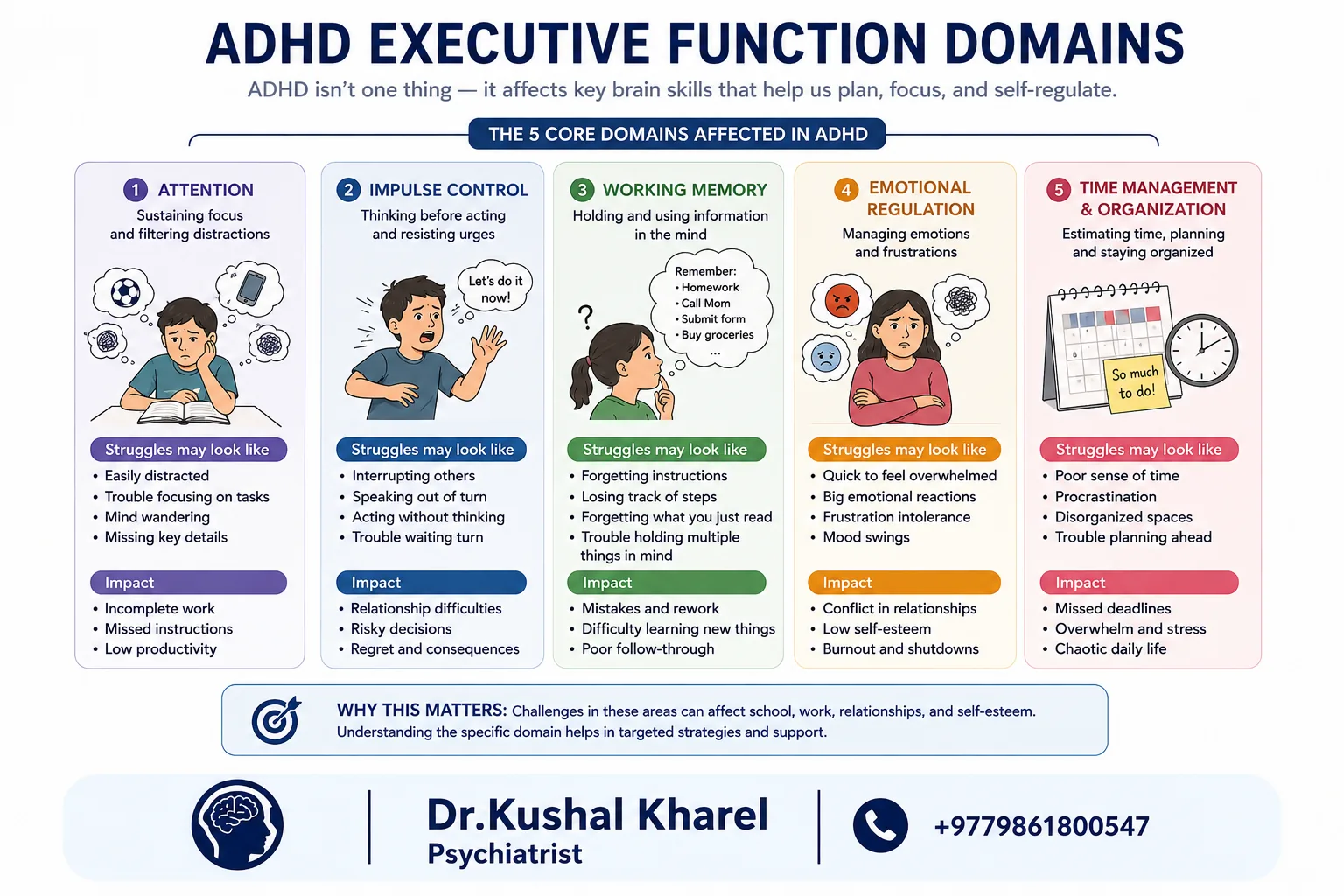
Definition
ADHD requires six or more symptoms of inattention and/or six or more symptoms of hyperactivity-impulsivity (five or more for individuals aged 17 and older) persisting for six months or more, with several symptoms present before age 12, occurring in two or more settings, and clear evidence that the symptoms interfere with social, academic, or occupational functioning. The presentation is specified as predominantly inattentive, predominantly hyperactive-impulsive, or combined.
What causes Attention-Deficit/Hyperactivity Disorder (ADHD)?
ADHD is one of the most heritable psychiatric conditions, with genetic factors accounting for an estimated 70–80% of risk. It reflects dysregulation of dopamine and norepinephrine signaling within prefrontal-striatal brain circuits that govern attention, impulse control, and executive function. Additional contributing factors include prenatal exposure to alcohol or tobacco and premature birth or low birth weight. ADHD is not caused by poor parenting or excessive sugar or screen time, though these factors can influence how symptoms are expressed day to day.
What are the risk factors for Attention-Deficit/Hyperactivity Disorder (ADHD)?
- Family history of ADHD (the strongest known risk factor)
- Premature birth or low birth weight
- Prenatal exposure to alcohol, tobacco, or certain toxins
- Male sex (diagnosed more often in boys, though girls are frequently underdiagnosed due to a more inattentive, less disruptive presentation)
- Significant early childhood adversity
What happens in the brain with Attention-Deficit/Hyperactivity Disorder (ADHD)?
ADHD involves dysregulation of dopamine and norepinephrine within the prefrontal cortex-striatal circuits responsible for sustained attention, impulse control, and executive function. Some longitudinal imaging studies show delayed cortical maturation, particularly in the prefrontal cortex, along with subtle volume differences in regions such as the basal ganglia and cerebellum. This neurochemical basis explains why stimulant medications, which increase dopamine and norepinephrine availability, are effective for most people with ADHD.
What are the symptoms of Attention-Deficit/Hyperactivity Disorder (ADHD)?
- Difficulty sustaining attention on tasks or activities
- Careless mistakes, failing to finish tasks, or difficulty organizing
- Avoiding or disliking tasks requiring sustained mental effort
- Losing things needed for tasks, being easily distracted, and forgetfulness in daily activities
- Fidgeting, squirming, or leaving one's seat when expected to remain seated
- A subjective sense of restlessness (particularly in adults) or excessive running/climbing (in children)
- Talking excessively, blurting out answers, or interrupting others
- Difficulty waiting one's turn
How is Attention-Deficit/Hyperactivity Disorder (ADHD) diagnosed?
- Six or more inattentive symptoms and/or six or more hyperactive-impulsive symptoms (five or more for those aged 17+) persisting 6+ months
- Symptoms inconsistent with developmental level
- Several symptoms present before age 12
- Present in two or more settings (home, school, work, social)
- Clear evidence of interference with social, academic, or occupational functioning
- Not better explained by another mental disorder
Differential Diagnosis
Conditions a psychiatrist will consider and rule out before confirming this diagnosis:
- Normal developmental variation
- Age-appropriate activity levels in young children should not be mistaken for ADHD without meeting the full diagnostic threshold.
- Autism Spectrum Disorder
- Frequently co-occurs, but is distinguished by core social communication differences not explained by attention or impulse regulation alone.
- Learning disorders
- Can mimic inattention when a child struggles to understand academic material, rather than reflecting a primary attention deficit.
- Anxiety and mood disorders
- Worry, irritability, or distractibility from anxiety, depression, or mania can resemble ADHD symptoms.
- Hearing or vision problems
- Can present as apparent inattention and should be excluded with appropriate screening.
- Sleep disorders
- Poor sleep can produce inattention and hyperactivity resembling ADHD.
What tests are used to assess Attention-Deficit/Hyperactivity Disorder (ADHD)?
- Comprehensive clinical interview with the individual and, for children, parents and teachers
- Standardized rating scales (e.g., Conners, Vanderbilt for children; ASRS for adults)
- Review of school records and academic history for children
- Hearing and vision screening
- Sleep assessment
- Screening for co-occurring learning disorders, anxiety, or depression
How is Attention-Deficit/Hyperactivity Disorder (ADHD) treated?
Stimulant medication is first-line and highly effective for core symptoms in most patients. Behavioral interventions and parent training are especially important for younger children, and combination treatment (medication plus behavioral strategies) is often optimal. Academic and workplace accommodations complement medical treatment.
Treatment at a Glance
| Type | Approach | Notes |
|---|---|---|
| Medication | Stimulants (methylphenidate, amphetamine/dextroamphetamine formulations) | First-line and highly effective for the majority of patients. |
| Medication | Atomoxetine | A non-stimulant alternative, useful when stimulants are not tolerated or are contraindicated. |
| Medication | Guanfacine or clonidine (extended-release) | Non-stimulant options, particularly useful with co-occurring tics or significant anxiety. |
| Psychotherapy | Behavioral parent training | The most evidence-based non-medication intervention for younger children with ADHD. |
| Psychotherapy | Behavioral classroom management | Structured strategies implemented by teachers to support attention and behavior in school. |
| Psychotherapy | CBT for adolescents/adults | Focuses on organizational skills, time management, and addressing negative self-view built up from years of struggle. |
| Psychotherapy | Social skills training | Supports peer relationships affected by impulsivity or inattention. |
What medications are used for Attention-Deficit/Hyperactivity Disorder (ADHD)?
- Stimulants (methylphenidate, amphetamine/dextroamphetamine formulations)
- First-line and highly effective for the majority of patients.
- Atomoxetine
- A non-stimulant alternative, useful when stimulants are not tolerated or are contraindicated.
- Guanfacine or clonidine (extended-release)
- Non-stimulant options, particularly useful with co-occurring tics or significant anxiety.
What therapy helps with Attention-Deficit/Hyperactivity Disorder (ADHD)?
- Behavioral parent training
- The most evidence-based non-medication intervention for younger children with ADHD.
- Behavioral classroom management
- Structured strategies implemented by teachers to support attention and behavior in school.
- CBT for adolescents/adults
- Focuses on organizational skills, time management, and addressing negative self-view built up from years of struggle.
- Social skills training
- Supports peer relationships affected by impulsivity or inattention.
What lifestyle changes help with Attention-Deficit/Hyperactivity Disorder (ADHD)?
- Maintain structured routines and consistent daily schedules
- Break tasks into smaller, manageable steps
- Use planners, reminders, and organizational tools consistently
- Engage in regular physical exercise, shown to support attention and executive function
- Prioritize adequate sleep
- Use consistent positive reinforcement for children rather than relying mainly on punishment
What is the long-term outlook for Attention-Deficit/Hyperactivity Disorder (ADHD)?
ADHD symptoms often persist into adulthood for the majority of people diagnosed in childhood, though hyperactivity tends to lessen over time while inattention and executive function difficulties frequently continue. With appropriate treatment, most people achieve significant functional improvement. Untreated ADHD is associated with academic underachievement, occupational difficulties, relationship problems, and higher rates of substance use and accidents.
Can Attention-Deficit/Hyperactivity Disorder (ADHD) be prevented?
- Early identification and intervention, which improves long-term outcomes
- Avoiding prenatal exposure to alcohol and tobacco
- Early treatment of co-occurring learning, anxiety, or mood difficulties
- School-based support programs for at-risk children
How can family help someone with Attention-Deficit/Hyperactivity Disorder (ADHD)?
Understand ADHD as a genuine neurodevelopmental condition, not a discipline problem or a result of parenting style. Provide consistent structure and routine, use positive reinforcement, and collaborate with schools on appropriate accommodations. Avoid excessive punishment for symptoms that are neurologically driven rather than willful, support medication adherence if prescribed, and address your own frustration or caregiver burnout, which is common and valid.
Frequently Asked Questions
Is ADHD overdiagnosed?
While diagnosis rates have increased with greater awareness, ADHD remains a genuine neurodevelopmental condition with a strong biological basis — increased recognition, particularly of inattentive-type presentations and adult ADHD, largely reflects improved identification rather than overdiagnosis alone.
Do people 'grow out of' ADHD?
Hyperactivity symptoms often lessen with age, but inattention and executive function difficulties frequently persist into adulthood for most people diagnosed in childhood, even if the presentation changes.
Does sugar cause ADHD?
No. This is a persistent myth not supported by research; ADHD has a strong genetic and neurobiological basis, though diet and routine can still affect how symptoms are experienced day to day.
Are stimulant medications safe long-term?
When properly prescribed and monitored by a physician, stimulant medications are considered safe and effective for long-term ADHD management, and appropriately treated ADHD is actually associated with lower rates of later substance use disorder compared to untreated ADHD.
Can adults have ADHD?
Yes. ADHD frequently persists from childhood into adulthood, and it can also first be recognized in adulthood, particularly the inattentive presentation, which is often missed earlier in life because it's less disruptive than hyperactivity.
How is ADHD diagnosed?
Diagnosis involves a clinical interview, standardized rating scales completed by the individual (and parents/teachers for children), a review of symptom history back to childhood, and ruling out other explanations like anxiety, learning disorders, or sleep problems.
Can ADHD be mistaken for anxiety or depression?
Yes. Inattention, restlessness, and irritability can overlap across ADHD, anxiety, and depression, and the conditions frequently co-occur, which is why a thorough evaluation is needed to identify which conditions are actually present.
What treatments are available for ADHD?
Stimulant medications are first-line and highly effective for most patients. Non-stimulant medications are an alternative, and behavioral parent training, classroom strategies, and CBT for organizational skills support medication or serve as primary treatment in milder cases.
Is ADHD lifelong?
For most people diagnosed in childhood, some ADHD traits persist into adulthood, though hyperactivity often lessens while attention and organizational difficulties tend to continue. Treatment substantially improves functioning at any age.
What causes ADHD?
ADHD is one of the most heritable psychiatric conditions, arising from dysregulation of dopamine and norepinephrine in brain circuits governing attention and impulse control, with genetics accounting for roughly 70-80% of risk.
Is there an ADHD specialist in Nepal?
Yes. Dr. Kushal Kharel is a Consultant Psychiatrist in Nepal who assesses and treats ADHD in children, adolescents and adults, offering evidence-based medication management and behavioral strategies, in person in Kathmandu or online.
Myth vs Fact
Myth: ADHD is caused by bad parenting or too much sugar or screen time.
Fact: ADHD has a strong genetic and neurobiological basis; parenting style, sugar, and screen time do not cause it, though they can influence symptom expression.
Myth: ADHD is just an excuse for laziness.
Fact: ADHD involves genuine impairment in the brain's attention and executive function regulation systems, not a lack of effort or character.
Myth: Only hyperactive boys have ADHD.
Fact: Girls and individuals with the inattentive presentation are frequently underdiagnosed, since their symptoms are often less disruptive and less immediately noticeable.
When should you seek urgent care for Attention-Deficit/Hyperactivity Disorder (ADHD)?
Seek prompt evaluation for severe impulsivity leading to dangerous or risky behavior, significant co-occurring depression or anxiety with safety concerns, or medication side effects requiring urgent review, such as significant cardiovascular symptoms or severe mood changes.
References
- American Psychiatric Association. Diagnostic and Statistical Manual of Mental Disorders, 5th Edition, Text Revision (DSM-5-TR).
- World Health Organization. International Classification of Diseases, 11th Revision (ICD-11).
- American Academy of Pediatrics. ADHD Clinical Practice Guideline.
- National Institute for Health and Care Excellence (NICE). Attention deficit hyperactivity disorder: diagnosis and management.
Related Neurodevelopmental Disorders
Need professional help?
If these symptoms are affecting your sleep, work, relationships or daily functioning, a psychiatric assessment can help clarify the diagnosis and treatment plan.