Key Facts
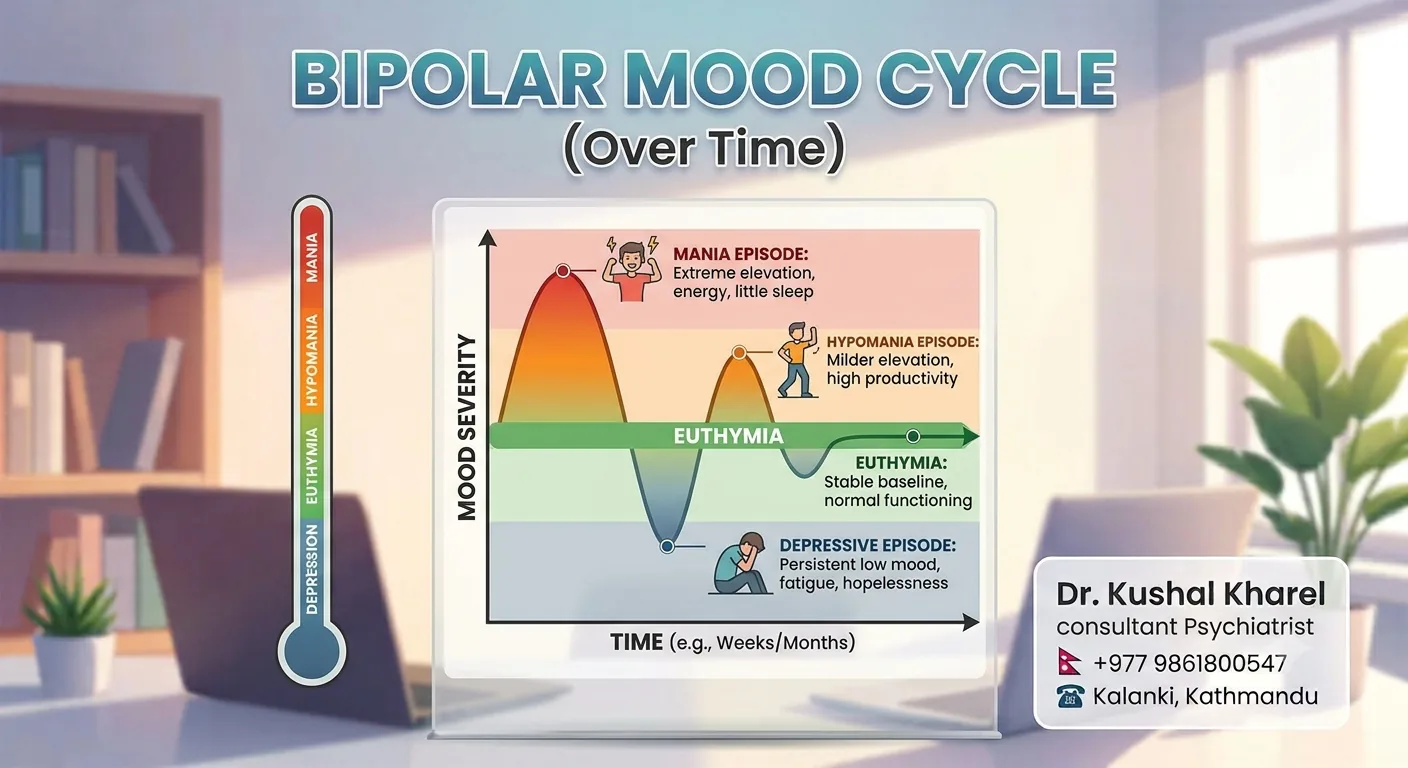
Bipolar II Disorder involves at least one hypomanic episode — a milder, shorter version of mania that does not cause marked impairment, psychosis, or require hospitalization — together with at least one major depressive episode. Depression is often the more prominent and impairing feature of the illness, while hypomania may feel pleasant, productive, or simply like 'a good period,' meaning it frequently goes unreported or unrecognized. This commonly leads to years of misdiagnosis and treatment as unipolar depression before the bipolar pattern is correctly identified.
Common symptoms
- Hypomanic episode: elevated, expansive, or irritable mood with increased energy
- Decreased need for sleep
- More talkative than usual
- Racing thoughts
Key risk factors
- Family history of bipolar disorder (Bipolar I or II) or depression
- Sleep deprivation
- Antidepressant treatment without a mood stabilizer, which can trigger hypomania
What is Bipolar II Disorder?
Bipolar II Disorder involves at least one hypomanic episode — a milder, shorter version of mania that does not cause marked impairment, psychosis, or require hospitalization — together with at least one major depressive episode. Depression is often the more prominent and impairing feature of the illness, while hypomania may feel pleasant, productive, or simply like 'a good period,' meaning it frequently goes unreported or unrecognized. This commonly leads to years of misdiagnosis and treatment as unipolar depression before the bipolar pattern is correctly identified.
Definition
Bipolar II Disorder requires at least one hypomanic episode — a distinct period of abnormally elevated, expansive, or irritable mood and increased activity lasting at least four consecutive days, with three or more (four if irritable only) characteristic symptoms and an unequivocal change in functioning observable by others, but without marked impairment, psychotic features, or hospitalization — together with at least one major depressive episode, and no lifetime history of a full manic episode.
What causes Bipolar II Disorder?
Bipolar II Disorder shares a genetic and neurobiological basis with Bipolar I Disorder, and family studies show it can run in families either alongside or independently of Bipolar I, suggesting a related but somewhat distinct position on the bipolar spectrum. The same triggers implicated in Bipolar I — sleep disruption, antidepressant use without a mood stabilizer, and the postpartum period — are also relevant.
What are the risk factors for Bipolar II Disorder?
- Family history of bipolar disorder (Bipolar I or II) or depression
- Sleep deprivation
- Antidepressant treatment without a mood stabilizer, which can trigger hypomania
- Postpartum period
- High-stress or highly stimulating life events
What happens in the brain with Bipolar II Disorder?
Bipolar II shares much of the same underlying dopaminergic and circadian dysregulation seen in Bipolar I, though the elevated mood states are less severe. The depressive phase shows substantial mechanistic overlap with unipolar Major Depressive Disorder, which is part of why bipolar II depression is so often initially mistaken for it.
What are the symptoms of Bipolar II Disorder?
- Hypomanic episode: elevated, expansive, or irritable mood with increased energy
- Decreased need for sleep
- More talkative than usual
- Racing thoughts
- Increased goal-directed activity, noticeable to others but without severe impairment
- Mildly risky behavior, without the severe consequences seen in full mania
- Major depressive episodes, often more frequent and prominent than hypomanic periods
- Depressive episodes sometimes with 'atypical' features — increased sleep and appetite rather than the classic insomnia/appetite loss
How is Bipolar II Disorder diagnosed?
- At least one hypomanic episode: 4+ days, 3+ symptoms, an observable change in functioning, but without marked impairment, hospitalization, or psychosis
- At least one major depressive episode
- No lifetime history of a full manic episode (which would instead indicate Bipolar I Disorder)
Differential Diagnosis
Conditions a psychiatrist will consider and rule out before confirming this diagnosis:
- Bipolar I Disorder
- Distinguished by the presence of even one full manic episode; Bipolar II is diagnosed only when mania has never occurred.
- Major Depressive Disorder
- Careful screening for any past hypomanic episode is essential, since Bipolar II is frequently misdiagnosed as unipolar depression, and unopposed antidepressant treatment can worsen the underlying course.
- Cyclothymic Disorder
- Involves milder, more chronic mood instability that does not meet full criteria for a hypomanic or major depressive episode.
- Borderline Personality Disorder
- Mood reactivity in BPD is typically brief (hours) and tied to interpersonal triggers, rather than the sustained, multi-day episodes seen in bipolar II.
- ADHD
- Overlapping features of distractibility and high energy, but with a chronic rather than episodic course.
What tests are used to assess Bipolar II Disorder?
- Detailed clinical interview with careful, specific screening for any past hypomanic episodes, since patients typically present during the depressive phase and may not recognize hypomania as abnormal
- Mood Disorder Questionnaire (MDQ) and Hypomania Checklist (HCL-32)
- Collateral history from family, often more revealing than self-report for hypomanic periods
How is Bipolar II Disorder treated?
Mood stabilizers with particular evidence for the depressive phase — lamotrigine and quetiapine — are central to treatment, since depression is often the more burdensome feature of Bipolar II. Antidepressants are generally avoided as monotherapy and, if used, are combined with a mood stabilizer to reduce the risk of triggering hypomania or destabilizing the mood cycle.
Treatment at a Glance
| Type | Approach | Notes |
|---|---|---|
| Medication | Lamotrigine | Particularly effective for preventing depressive episodes in bipolar II disorder. |
| Medication | Quetiapine | Specifically approved for bipolar depression, including in Bipolar II Disorder. |
| Medication | Lithium | Can be used, though the evidence base is more robust for Bipolar I than specifically for Bipolar II. |
| Psychotherapy | Psychoeducation | Helps the person recognize the hypomania-depression pattern, particularly since hypomania often does not feel like a problem at the time. |
| Psychotherapy | Interpersonal and Social Rhythm Therapy (IPSRT) | Stabilizes sleep and daily routines to reduce episode frequency. |
| Psychotherapy | Cognitive Behavioral Therapy | Adapted for bipolar depression, the most burdensome feature for most patients. |
| Psychotherapy | Family-Focused Therapy | Helps family members recognize the pattern and support consistent treatment. |
What medications are used for Bipolar II Disorder?
- Lamotrigine
- Particularly effective for preventing depressive episodes in bipolar II disorder.
- Quetiapine
- Specifically approved for bipolar depression, including in Bipolar II Disorder.
- Lithium
- Can be used, though the evidence base is more robust for Bipolar I than specifically for Bipolar II.
What therapy helps with Bipolar II Disorder?
- Psychoeducation
- Helps the person recognize the hypomania-depression pattern, particularly since hypomania often does not feel like a problem at the time.
- Interpersonal and Social Rhythm Therapy (IPSRT)
- Stabilizes sleep and daily routines to reduce episode frequency.
- Cognitive Behavioral Therapy
- Adapted for bipolar depression, the most burdensome feature for most patients.
- Family-Focused Therapy
- Helps family members recognize the pattern and support consistent treatment.
What lifestyle changes help with Bipolar II Disorder?
- Maintain a consistent sleep-wake schedule
- Track mood, sleep, and energy to identify early hypomanic or depressive signs
- Avoid alcohol and recreational substances, which can destabilize mood
- Build structured daily routines and manage stress proactively
What is the long-term outlook for Bipolar II Disorder?
In Bipolar II Disorder, depressive episodes tend to be more frequent and often more impairing than hypomanic episodes, and depression can be more treatment-resistant than in Bipolar I. With appropriate mood-stabilizing treatment, significant improvement is achievable, though a minority of individuals go on to experience a full manic episode over time, at which point the diagnosis would be revised to Bipolar I.
Can Bipolar II Disorder be prevented?
- Accurate, early diagnosis to avoid years of misdiagnosis and treatment as unipolar depression
- Maintenance mood-stabilizing treatment
- Avoiding antidepressant monotherapy without a mood stabilizer
- Protecting regular sleep patterns
How can family help someone with Bipolar II Disorder?
Understand that hypomania often feels good to the person experiencing it — increased confidence, productivity, and energy — which can make them reluctant to see it as part of an illness or to adhere to treatment that 'levels out' this state. Help track the pattern over time (noticing the shift from a baseline into hypomania or depression) rather than judging any single mood state in isolation, support consistent treatment, and take depressive-phase safety concerns seriously given the significant depression burden in this condition.
Frequently Asked Questions
Is Bipolar II just a 'milder form' of Bipolar I?
Not necessarily in terms of overall burden — while hypomania is less severe than mania, the depressive episodes in Bipolar II are often more frequent and can be just as severe and impairing as in Bipolar I, including significant suicide risk.
Why was I diagnosed with depression for years before this?
This is very common. Because people with Bipolar II usually seek help during depressive episodes and hypomania often isn't recognized as a problem, many are initially and repeatedly diagnosed with unipolar depression before the bipolar pattern is identified.
Can hypomania actually feel enjoyable?
Yes, many people describe hypomania as feeling confident, productive, and energized — which is part of why it often goes unreported to a doctor and why family observation of the pattern over time is so valuable for accurate diagnosis.
Myth vs Fact
Myth: Bipolar II isn't serious since it doesn't involve full mania.
Fact: The depressive burden and suicide risk in Bipolar II can be substantial and, for many patients, are more impairing over time than the hypomanic episodes.
Myth: If hypomania doesn't feel bad, it can't be part of a disorder.
Fact: Hypomania is defined by an observable change in functioning noticed by others, regardless of whether it subjectively feels pleasant to the person experiencing it.
When should you seek urgent care for Bipolar II Disorder?
Seek urgent psychiatric care for suicidal thoughts during a depressive episode — a significant risk given how prominent depression is in Bipolar II — or if hypomanic symptoms begin escalating toward a full manic episode, which requires urgent reassessment and treatment adjustment.
References
- American Psychiatric Association. Diagnostic and Statistical Manual of Mental Disorders, 5th Edition, Text Revision (DSM-5-TR).
- World Health Organization. International Classification of Diseases, 11th Revision (ICD-11).
- National Institute for Health and Care Excellence (NICE). Bipolar disorder: assessment and management.
Related Bipolar and Related Disorders
Need professional help?
If these symptoms are affecting your sleep, work, relationships or daily functioning, a psychiatric assessment can help clarify the diagnosis and treatment plan.