Key Facts
Insomnia Disorder is one of the most common sleep complaints, involving dissatisfaction with sleep quantity or quality — difficulty initiating sleep, difficulty maintaining sleep, or early-morning awakening with an inability to return to sleep. It occurs despite adequate opportunity for sleep and causes significant distress or impairment in daytime functioning. Insomnia can occur as a standalone condition or alongside other psychiatric or medical conditions, and in either case can be an independent focus of treatment.
Common symptoms
- Difficulty falling asleep (sleep-onset insomnia)
- Frequent nighttime awakenings with difficulty returning to sleep (sleep-maintenance insomnia)
- Early-morning awakening with inability to return to sleep
- Non-restorative, unsatisfying sleep
Key risk factors
- Female sex
- Older age
- Family history of insomnia
Am I too sleepy during the day?
Take a free, confidential self-rated screening for insomnia disorder.
Downloadable resources
What is Insomnia Disorder?
Insomnia Disorder is one of the most common sleep complaints, involving dissatisfaction with sleep quantity or quality — difficulty initiating sleep, difficulty maintaining sleep, or early-morning awakening with an inability to return to sleep. It occurs despite adequate opportunity for sleep and causes significant distress or impairment in daytime functioning. Insomnia can occur as a standalone condition or alongside other psychiatric or medical conditions, and in either case can be an independent focus of treatment.
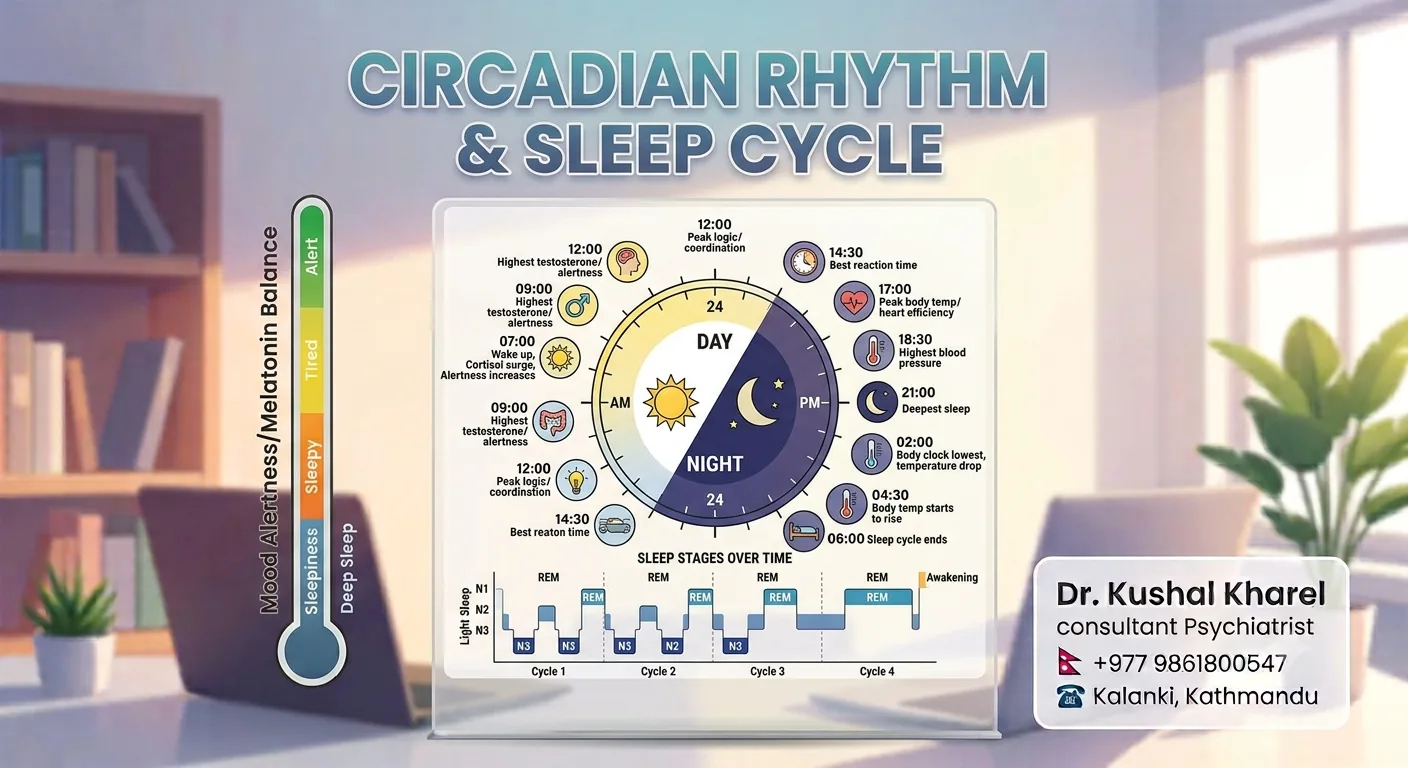
Definition
Insomnia Disorder is defined by dissatisfaction with sleep quantity or quality, with at least one of: difficulty initiating sleep, difficulty maintaining sleep, or early-morning awakening with inability to return to sleep, occurring three or more nights per week for three months or more, despite adequate opportunity for sleep, and causing significant distress or impairment.
What causes Insomnia Disorder?
Insomnia is understood through the '3P model': predisposing factors (genetic vulnerability, a trait-level tendency toward hyperarousal, an anxious temperament), precipitating factors (an acute stressor, illness, or life change that triggers an episode), and perpetuating factors (maladaptive behaviors that develop in response to poor sleep — such as spending excessive time in bed awake or worrying about sleep — that maintain the insomnia even after the original trigger has resolved). Over time, the bed and bedroom can become conditioned cues for wakefulness and frustration rather than sleep.
What are the risk factors for Insomnia Disorder?
- Female sex
- Older age
- Family history of insomnia
- An anxious or ruminative temperament
- Shift work
- Chronic pain or medical illness
- Co-occurring psychiatric conditions, especially depression and anxiety, which share a bidirectional relationship with insomnia
- Caffeine or stimulant use
- An irregular sleep schedule
What happens in the brain with Insomnia Disorder?
Chronic insomnia is associated with a state of physiological 'hyperarousal' — studies show increased metabolic rate, elevated cortisol, and increased high-frequency brain activity during sleep in affected individuals, suggesting heightened cognitive and physiological arousal that interferes with normal sleep processes. This reflects a dysregulated balance between the brain's sleep-promoting circuits (centered on the hypothalamus's ventrolateral preoptic nucleus) and wake-promoting circuits (including the orexin/hypocretin system).
What are the symptoms of Insomnia Disorder?
- Difficulty falling asleep (sleep-onset insomnia)
- Frequent nighttime awakenings with difficulty returning to sleep (sleep-maintenance insomnia)
- Early-morning awakening with inability to return to sleep
- Non-restorative, unsatisfying sleep
- Daytime fatigue and low energy
- Difficulty concentrating
- Irritability or low mood
- Preoccupation or worry about sleep itself
- Impaired work, academic, or social functioning
How is Insomnia Disorder diagnosed?
- Dissatisfaction with sleep quantity or quality, with one or more of: difficulty initiating sleep, difficulty maintaining sleep, or early-morning awakening
- Occurring 3 or more nights per week for 3 or more months
- Adequate opportunity for sleep
- Causes significant distress or impairment
- Not better explained solely by another sleep-wake disorder, substance effects, or a coexisting condition
Differential Diagnosis
Conditions a psychiatrist will consider and rule out before confirming this diagnosis:
- Short-term/adjustment insomnia
- Lasts less than three months and is tied to an identifiable stressor, not meeting the duration threshold for chronic Insomnia Disorder.
- Circadian Rhythm Sleep-Wake Disorders
- Sleep difficulty results from a mismatch between desired and biological sleep timing, rather than a true inability to sleep.
- Obstructive Sleep Apnea
- Should be screened for, especially with loud snoring, witnessed breathing pauses, or excessive daytime sleepiness, since it commonly coexists with or mimics insomnia symptoms.
- Restless Legs Syndrome
- Uncomfortable leg sensations specifically interfere with sleep onset.
- Depression or anxiety disorders
- Sleep disturbance is a core symptom of these conditions; insomnia can still be diagnosed alongside them when it is an independent focus needing its own treatment.
- Inadequate sleep opportunity
- Insufficient time allotted for sleep, rather than a true inability to sleep when given the chance.
What tests are used to assess Insomnia Disorder?
- Detailed sleep history and a 2+ week sleep diary
- Insomnia Severity Index questionnaire
- Screening for co-occurring depression or anxiety
- Screening for other sleep disorders (snoring, breathing pauses, restless legs symptoms)
- Polysomnography (a sleep study), generally reserved for cases where another sleep disorder such as sleep apnea is suspected, rather than routine for straightforward insomnia
How is Insomnia Disorder treated?
Cognitive Behavioral Therapy for Insomnia (CBT-I) is first-line treatment and is recommended ahead of medication in most guidelines, given comparable or superior long-term effectiveness without medication side effects or dependence risk. Medication may still be used short-term, or when CBT-I is not accessible or sufficient on its own.
Treatment at a Glance
| Type | Approach | Notes |
|---|---|---|
| Medication | Short-term hypnotics (e.g., zolpidem, eszopiclone, zaleplon) | Generally recommended for short-term use given dependence and tolerance concerns with longer-term use. |
| Medication | Dual orexin receptor antagonists (e.g., suvorexant, lemborexant) | A newer medication class targeting the wake-promoting orexin system. |
| Medication | Low-dose trazodone or mirtazapine | Sedating antidepressants sometimes used, particularly when depression coexists. |
| Medication | Melatonin | Modest evidence for insomnia itself; most useful for circadian-related sleep timing issues rather than insomnia directly. |
| Medication | Benzodiazepines | Generally avoided for chronic insomnia given dependence risk and disruptive effects on sleep architecture. |
| Psychotherapy | Cognitive Behavioral Therapy for Insomnia (CBT-I) | The gold-standard treatment, combining stimulus control, sleep restriction, cognitive restructuring, and relaxation training. |
| Psychotherapy | Stimulus control | Re-associates the bed specifically with sleep, rather than wakefulness or frustration. |
| Psychotherapy | Sleep restriction | Temporarily limits time in bed to consolidate and strengthen sleep drive. |
What medications are used for Insomnia Disorder?
- Short-term hypnotics (e.g., zolpidem, eszopiclone, zaleplon)
- Generally recommended for short-term use given dependence and tolerance concerns with longer-term use.
- Dual orexin receptor antagonists (e.g., suvorexant, lemborexant)
- A newer medication class targeting the wake-promoting orexin system.
- Low-dose trazodone or mirtazapine
- Sedating antidepressants sometimes used, particularly when depression coexists.
- Melatonin
- Modest evidence for insomnia itself; most useful for circadian-related sleep timing issues rather than insomnia directly.
- Benzodiazepines
- Generally avoided for chronic insomnia given dependence risk and disruptive effects on sleep architecture.
What therapy helps with Insomnia Disorder?
- Cognitive Behavioral Therapy for Insomnia (CBT-I)
- The gold-standard treatment, combining stimulus control, sleep restriction, cognitive restructuring, and relaxation training.
- Stimulus control
- Re-associates the bed specifically with sleep, rather than wakefulness or frustration.
- Sleep restriction
- Temporarily limits time in bed to consolidate and strengthen sleep drive.
What lifestyle changes help with Insomnia Disorder?
- Keep a consistent sleep-wake schedule, including on weekends
- Avoid caffeine, especially in the afternoon and evening
- Limit alcohol, which disrupts sleep architecture despite its initial sedating effect
- Avoid daytime napping if it worsens nighttime sleep
- Reserve the bedroom for sleep only, avoiding work or screens in bed
- Get out of bed if unable to sleep after about 20 minutes, rather than lying awake frustrated
- Get regular daytime physical activity and natural light exposure
- Maintain a calming wind-down routine before bed, avoiding bright screens
What is the long-term outlook for Insomnia Disorder?
With CBT-I, the majority of people achieve significant, durable improvement in sleep quality, often maintained long-term without ongoing medication. Untreated chronic insomnia is associated with an increased risk of depression, anxiety, reduced quality of life, and potentially cardiovascular and metabolic health effects.
Can Insomnia Disorder be prevented?
- Maintaining good sleep hygiene proactively
- Addressing acute stress-related sleep disruption early, before maladaptive sleep behaviors become entrenched
- Treating co-occurring psychiatric or medical conditions that affect sleep
- Avoiding excessive reliance on hypnotic medication, which can perpetuate rather than resolve the underlying pattern
How can family help someone with Insomnia Disorder?
Avoid pressuring the person about their sleep, which can increase performance anxiety around sleeping. Support consistent sleep-wake routines within the household, and understand that 'trying harder' to sleep often backfires — CBT-I techniques may initially involve less time in bed (sleep restriction), which can seem counterintuitive but is evidence-based. Encourage professional treatment rather than prolonged reliance on over-the-counter sleep aids alone.
How to Improve Sleep Hygiene
Daily habits that support the body's natural sleep drive and circadian rhythm, forming the foundation of insomnia treatment alongside CBT-I.
Step 1: Keep a consistent sleep-wake schedule
Go to bed and wake up at the same time every day, including on weekends, to stabilize your body's internal clock.
Step 2: Cut caffeine in the afternoon and evening
Avoid caffeine, especially from mid-afternoon onward, since it can remain in the body for hours and interfere with sleep onset.
Step 3: Limit alcohol
Alcohol may feel sedating initially but disrupts sleep architecture later in the night, leading to lighter, more fragmented sleep.
Step 4: Avoid daytime naps if they worsen your nighttime sleep
If napping is reducing your natural sleep drive at night, skip it or limit it to a short nap earlier in the day.
Step 5: Reserve the bedroom for sleep only
Avoid working or using screens in bed, so your brain associates the bedroom specifically with sleep rather than wakeful activity.
Step 6: Get out of bed if you can't sleep after about 20 minutes
Lying awake and frustrated reinforces the bed as a place of wakefulness. Get up, do something calming in dim light, and return when sleepy.
Step 7: Get daytime physical activity and natural light
Regular exercise and morning light exposure help reinforce a healthy circadian rhythm and strengthen nighttime sleep drive.
Step 8: Wind down before bed
Keep a calming pre-sleep routine and avoid bright screens in the hour before bed, since blue light can delay the body's natural melatonin release.
Frequently Asked Questions
Is it normal to need sleep medication forever?
Not necessarily — most guidelines recommend CBT-I as the first-line, longer-term solution, with medication reserved for short-term use or when CBT-I isn't sufficient or accessible on its own.
Why does trying harder to sleep make it worse?
Effortful 'trying' to sleep increases mental and physiological arousal, which works directly against the relaxed state needed for sleep onset — this is part of why CBT-I focuses on reducing sleep-related effort and anxiety rather than increasing it.
Is melatonin a good treatment for insomnia?
Melatonin has only modest evidence for insomnia itself and is generally more useful for circadian timing issues (like jet lag or delayed sleep phase) than as a primary insomnia treatment.
Is there a sleep specialist psychiatrist in Nepal?
Yes. Dr. Kushal Kharel, a Consultant Psychiatrist in Kathmandu, treats insomnia and other sleep-wake disorders using evidence-based approaches such as CBT-I and, when appropriate, medication, in person or via online consultation.
Myth vs Fact
Myth: Everyone needs exactly 8 hours of sleep.
Fact: Sleep needs vary between individuals; the key marker of a problem is daytime impairment or distress, not deviation from a fixed number of hours.
Myth: Sleeping pills are the best long-term solution for insomnia.
Fact: CBT-I has comparable or superior long-term effectiveness without the dependence risk associated with long-term hypnotic medication use.
Myth: Lying in bed resting is just as good as sleeping if you can't fall asleep.
Fact: Spending excessive time in bed awake actually reinforces the association between bed and wakefulness, worsening chronic insomnia — getting up and returning when sleepy is often recommended instead.
When should you seek urgent care for Insomnia Disorder?
Insomnia itself is rarely a psychiatric emergency, but seek prompt evaluation if it is accompanied by significant depression or suicidal ideation, or for symptoms suggestive of a co-occurring sleep disorder like severe sleep apnea — choking or gasping during sleep, or severe daytime sleepiness affecting safety, such as while driving.
References
- American Psychiatric Association. Diagnostic and Statistical Manual of Mental Disorders, 5th Edition, Text Revision (DSM-5-TR).
- World Health Organization. International Classification of Diseases, 11th Revision (ICD-11).
- American Academy of Sleep Medicine. Clinical Practice Guideline for CBT-I.
From the Blog
Related Sleep-Wake Disorders
Need professional help?
If these symptoms are affecting your sleep, work, relationships or daily functioning, a psychiatric assessment can help clarify the diagnosis and treatment plan.