Key Facts
Major Depressive Disorder is one of the most common and disabling psychiatric conditions worldwide. It is characterized by episodes of persistent low mood and/or a marked loss of interest or pleasure in activities (anhedonia), accompanied by a range of physical symptoms — changes in sleep, appetite, and energy — and cognitive symptoms such as poor concentration, feelings of worthlessness, and, in more severe cases, thoughts of death or suicide. Episodes may occur once or recur throughout life, and severity ranges from mild to severe, occasionally with psychotic features.
Common symptoms
- Depressed mood most of the day, nearly every day
- Markedly diminished interest or pleasure in almost all activities (anhedonia)
- Significant weight loss or gain, or change in appetite
- Insomnia or hypersomnia (sleeping excessively)
Key risk factors
- Family history of depression or other mood disorders
- Female sex (depression is diagnosed roughly twice as often in women)
- History of trauma or adverse childhood experiences
Do I have depression?
Take a free, confidential self-rated screening for major depressive disorder (mdd).
Downloadable resources
What is Major Depressive Disorder (MDD)?
Major Depressive Disorder is one of the most common and disabling psychiatric conditions worldwide. It is characterized by episodes of persistent low mood and/or a marked loss of interest or pleasure in activities (anhedonia), accompanied by a range of physical symptoms — changes in sleep, appetite, and energy — and cognitive symptoms such as poor concentration, feelings of worthlessness, and, in more severe cases, thoughts of death or suicide. Episodes may occur once or recur throughout life, and severity ranges from mild to severe, occasionally with psychotic features.
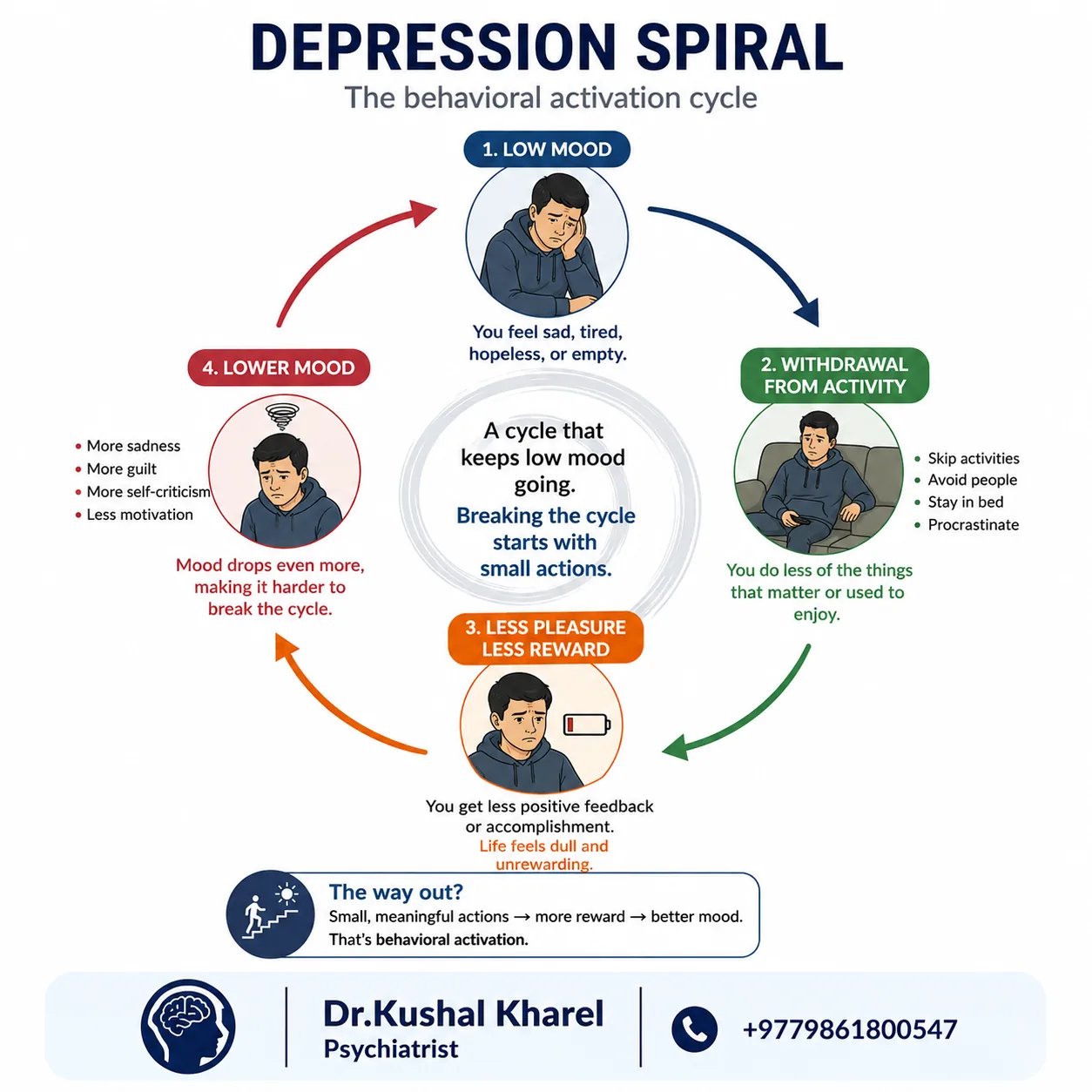
Definition
MDD is diagnosed when five or more specific symptoms are present during the same two-week period, representing a change from previous functioning, with at least one symptom being either depressed mood or loss of interest/pleasure. The symptoms cause clinically significant distress or impairment and are not attributable to a substance or another medical condition, and there has been no history of a manic or hypomanic episode.
What causes Major Depressive Disorder (MDD)?
MDD arises from a combination of genetic vulnerability (heritability of around 40%), dysregulation of neurotransmitter systems (serotonin, noradrenaline, and dopamine), and disruption of the hypothalamic-pituitary-adrenal (HPA) axis, which governs the body's stress-hormone response. Chronic stress, significant loss, trauma, and adverse childhood experiences increase vulnerability, and depression frequently co-occurs with or follows chronic medical illness.
What are the risk factors for Major Depressive Disorder (MDD)?
- Family history of depression or other mood disorders
- Female sex (depression is diagnosed roughly twice as often in women)
- History of trauma or adverse childhood experiences
- Chronic medical illness or chronic pain
- Major life stressors: loss, relationship breakdown, financial hardship
- Previous depressive episode (strongest predictor of a future episode)
- Postpartum period
- Substance use
- Low social support or social isolation
What happens in the brain with Major Depressive Disorder (MDD)?
The classic 'monoamine hypothesis' proposes reduced availability or signaling of serotonin, noradrenaline, and dopamine as central to depression, which underlies why antidepressants targeting these systems are effective. Chronic stress and elevated cortisol are associated with reduced hippocampal volume and impaired neuroplasticity, while the prefrontal cortex — involved in regulating mood and emotional responses — often shows reduced activity, alongside amygdala hyperactivity in response to negative stimuli. Emerging research also implicates neuroinflammation and disrupted connectivity within brain networks involved in self-referential thinking.
What are the symptoms of Major Depressive Disorder (MDD)?
- Depressed mood most of the day, nearly every day
- Markedly diminished interest or pleasure in almost all activities (anhedonia)
- Significant weight loss or gain, or change in appetite
- Insomnia or hypersomnia (sleeping excessively)
- Psychomotor agitation or retardation (restlessness or noticeably slowed movement/speech)
- Fatigue or loss of energy
- Feelings of worthlessness or excessive, inappropriate guilt
- Diminished ability to think, concentrate, or make decisions
- Recurrent thoughts of death, suicidal ideation, or a suicide attempt
How is Major Depressive Disorder (MDD) diagnosed?
- Five or more of the characteristic symptoms present during the same 2-week period, representing a change from previous functioning
- At least one symptom is either depressed mood or loss of interest/pleasure
- Causes clinically significant distress or impairment in functioning
- Not attributable to a substance or another medical condition
- No history of a manic or hypomanic episode (which would suggest bipolar disorder instead)
- Not better explained by another psychotic disorder, and not a normal grief reaction alone
Differential Diagnosis
Conditions a psychiatrist will consider and rule out before confirming this diagnosis:
- Bipolar Disorder
- It is essential to screen for any past hypomanic or manic episode before diagnosing MDD, since antidepressants alone can trigger mood destabilization in bipolar disorder.
- Persistent Depressive Disorder (Dysthymia)
- Involves a more chronic, typically milder depressed mood lasting 2+ years, rather than the more acute episodic pattern of MDD.
- Adjustment Disorder with Depressed Mood
- A clear identifiable stressor with a reaction that does not meet the full symptom threshold or duration of MDD.
- Normal grief/bereavement
- Grief can share features with depression, but complicated or prolonged grief with pervasive worthlessness or functional collapse may warrant an MDD diagnosis.
- Hypothyroidism
- Can present with fatigue, weight gain, and low mood; thyroid function tests help exclude this.
- Medication-induced depression
- Certain medications (e.g., corticosteroids, some hormonal treatments, interferon) can induce depressive symptoms.
What tests are used to assess Major Depressive Disorder (MDD)?
- Clinical psychiatric interview and detailed history
- PHQ-9 questionnaire to assess symptom severity
- Thyroid function tests, full blood count, vitamin B12 and folate levels
- Screening for any history of hypomania or mania to exclude bipolar disorder
- Structured suicide risk assessment
How is Major Depressive Disorder (MDD) treated?
Mild depression often responds well to psychotherapy alone. Moderate-to-severe depression generally requires a combination of psychotherapy (such as CBT or Interpersonal Therapy) and antidepressant medication. Severe depression with psychotic features, high suicide risk, or an inability to care for oneself may require hospitalization, and treatment-resistant or severe cases may be considered for electroconvulsive therapy (ECT), which remains one of the most effective treatments for severe depression.
Treatment at a Glance
| Type | Approach | Notes |
|---|---|---|
| Medication | SSRIs (e.g., sertraline, escitalopram, fluoxetine) | First-line antidepressants; generally well tolerated, taking 2–6 weeks for full effect. |
| Medication | SNRIs (e.g., venlafaxine, duloxetine) | An effective alternative, particularly useful when depression overlaps with chronic pain. |
| Medication | Atypical antidepressants (e.g., mirtazapine, bupropion) | Useful alternatives, particularly when sleep/appetite disturbance (mirtazapine) or low energy/motivation (bupropion) predominate. |
| Medication | Augmentation strategies (e.g., lithium, atypical antipsychotics) | Added to an antidepressant for treatment-resistant depression under specialist supervision. |
| Medication | Electroconvulsive Therapy (ECT) | Highly effective for severe, psychotic, or treatment-resistant depression, delivered under specialist care. |
| Psychotherapy | Cognitive Behavioral Therapy (CBT) | Addresses negative thought patterns and behavioral withdrawal that maintain depression. |
| Psychotherapy | Interpersonal Therapy (IPT) | Focuses on resolving relationship difficulties and role transitions contributing to depression. |
| Psychotherapy | Behavioral Activation | Structured re-engagement with rewarding and meaningful activities to counter withdrawal and low motivation. |
| Psychotherapy | Mindfulness-Based Cognitive Therapy (MBCT) | Particularly useful for relapse prevention after recovery from a depressive episode. |
What medications are used for Major Depressive Disorder (MDD)?
- SSRIs (e.g., sertraline, escitalopram, fluoxetine)
- First-line antidepressants; generally well tolerated, taking 2–6 weeks for full effect.
- SNRIs (e.g., venlafaxine, duloxetine)
- An effective alternative, particularly useful when depression overlaps with chronic pain.
- Atypical antidepressants (e.g., mirtazapine, bupropion)
- Useful alternatives, particularly when sleep/appetite disturbance (mirtazapine) or low energy/motivation (bupropion) predominate.
- Augmentation strategies (e.g., lithium, atypical antipsychotics)
- Added to an antidepressant for treatment-resistant depression under specialist supervision.
- Electroconvulsive Therapy (ECT)
- Highly effective for severe, psychotic, or treatment-resistant depression, delivered under specialist care.
What therapy helps with Major Depressive Disorder (MDD)?
- Cognitive Behavioral Therapy (CBT)
- Addresses negative thought patterns and behavioral withdrawal that maintain depression.
- Interpersonal Therapy (IPT)
- Focuses on resolving relationship difficulties and role transitions contributing to depression.
- Behavioral Activation
- Structured re-engagement with rewarding and meaningful activities to counter withdrawal and low motivation.
- Mindfulness-Based Cognitive Therapy (MBCT)
- Particularly useful for relapse prevention after recovery from a depressive episode.
What lifestyle changes help with Major Depressive Disorder (MDD)?
- Engage in regular physical exercise, which has evidence comparable to medication for mild-to-moderate depression
- Maintain a consistent sleep schedule and address sleep disturbance directly
- Stay socially engaged even when motivation is low, rather than withdrawing
- Establish a structured daily routine, especially when energy and motivation are reduced
- Limit alcohol, which is a depressant and can worsen symptoms
- Prioritize sunlight exposure and time outdoors where possible
What is the long-term outlook for Major Depressive Disorder (MDD)?
MDD is highly treatable, with most people experiencing substantial improvement with appropriate treatment. However, depression has a significant risk of recurrence — over 50% after a first episode, and higher after multiple episodes — which is why maintenance treatment is often recommended for people with recurrent depression, even after symptoms resolve.
Can Major Depressive Disorder (MDD) be prevented?
- Early treatment of emerging or subclinical depressive symptoms
- Ongoing stress management and building social support
- Maintenance antidepressant treatment or continued therapy for those with recurrent depression
- Addressing modifiable risk factors such as chronic sleep disruption or excessive alcohol use
How can family help someone with Major Depressive Disorder (MDD)?
Understand depression as a genuine medical illness, not a sign of weakness or a mood the person can simply choose to change. Avoid dismissive statements such as 'just cheer up' or 'think positive,' which can deepen feelings of guilt and isolation. Encourage — without forcing — engagement in activities and treatment, support medication adherence, and take any mention of suicidal thoughts seriously and seek help immediately. Caring for a depressed family member is also demanding, and caregivers benefit from their own support.
Frequently Asked Questions
Is depression just deep sadness?
No. While sadness is one feature, MDD involves a cluster of physical and cognitive symptoms — sleep and appetite changes, loss of interest, poor concentration, and sometimes suicidal thoughts — persisting for two weeks or more and significantly affecting functioning.
How long does antidepressant treatment take to work?
Most people notice initial improvement within 2–4 weeks, with fuller benefit by 6–8 weeks. If there is no improvement after an adequate trial, your psychiatrist may adjust the dose or try a different medication.
Will I need to take antidepressants forever?
Not necessarily. Many people take antidepressants for 6–12 months after a first episode and then taper off under medical supervision. Those with recurrent depression are often advised to continue longer-term maintenance treatment.
Can depression happen without an obvious cause?
Yes. While stress and loss are common triggers, depression can also develop without any clear precipitating event, reflecting underlying biological vulnerability.
What are the symptoms of depression?
Core symptoms include persistent low mood, loss of interest or pleasure in activities, changes in sleep and appetite, fatigue, poor concentration, feelings of worthlessness or guilt, and sometimes thoughts of death, lasting two weeks or more.
When should I seek help for depression?
Seek help when low mood, loss of interest, or other symptoms persist for two weeks or more and interfere with work, relationships, or daily functioning — or immediately if you have any thoughts of self-harm or suicide.
Can depression be treated without medication?
Yes, for mild-to-moderate depression, psychotherapy alone — particularly CBT or Interpersonal Therapy — is often effective. Moderate-to-severe depression generally responds best to a combination of therapy and medication.
How long does depression treatment take overall?
An initial course of treatment typically runs 6-12 months, though many people notice meaningful improvement within weeks. Given depression's high recurrence rate, longer-term maintenance treatment is often recommended, especially after multiple episodes.
Are antidepressants addictive?
No, antidepressants are not addictive in the way substances of abuse are. However, stopping them abruptly can cause discontinuation symptoms, which is why tapering off gradually under medical supervision is recommended.
Can depression return after recovery?
Yes. Depression has a significant recurrence risk — over 50% after a first episode, higher after subsequent episodes — which is why maintenance treatment and ongoing monitoring are often recommended even after full recovery.
What lifestyle changes help depression?
Regular exercise, a consistent sleep schedule, staying socially connected, limiting alcohol, and maintaining a structured daily routine all meaningfully support recovery, though moderate-to-severe depression usually also needs therapy and/or medication.
What happens during a psychiatric consultation for depression?
A psychiatric consultation typically includes a detailed history of your mood, sleep, appetite and functioning, screening for other conditions like bipolar disorder, a suicide risk assessment, and a discussion of therapy and/or medication options.
Is there a depression specialist in Nepal?
Yes. Dr. Kushal Kharel is a Consultant Psychiatrist and depression specialist in Kathmandu, Nepal, providing evidence-based diagnosis and treatment for major depressive disorder, in person or via online consultation.
Myth vs Fact
Myth: Depression is a sign of personal weakness.
Fact: Depression is a medical condition involving genuine changes in brain chemistry and function — it is not a character flaw or lack of willpower.
Myth: Antidepressants change your personality or make you feel 'fake happy.'
Fact: Effectively treated antidepressants relieve the symptoms of depression, allowing a person's genuine personality and interests to re-emerge, rather than creating an artificial state.
Myth: You can just 'snap out of' depression if you try hard enough.
Fact: Depression involves real physiological changes that willpower alone cannot reverse — appropriate treatment meaningfully changes the underlying biology and thought patterns.
When should you seek urgent care for Major Depressive Disorder (MDD)?
Seek immediate psychiatric or emergency care for any suicidal thoughts, plan, or intent, or if depression is accompanied by hallucinations or delusions (psychotic features). Urgent evaluation is also needed if a person is unable to care for their basic needs (eating, drinking, hygiene) due to depression.
References
- American Psychiatric Association. Diagnostic and Statistical Manual of Mental Disorders, 5th Edition, Text Revision (DSM-5-TR).
- World Health Organization. International Classification of Diseases, 11th Revision (ICD-11).
- National Institute for Health and Care Excellence (NICE). Depression in adults: treatment and management.
- World Health Organization. Depression fact sheet.
From the Blog
Related Depressive Disorders
Need professional help?
If these symptoms are affecting your sleep, work, relationships or daily functioning, a psychiatric assessment can help clarify the diagnosis and treatment plan.