Key Facts
Obsessive-Compulsive Disorder involves obsessions — recurrent, intrusive, unwanted thoughts, images, or urges that cause significant anxiety — and/or compulsions, repetitive behaviors or mental acts performed to reduce that anxiety or prevent a feared outcome. Common themes include contamination and cleaning, symmetry and ordering, fears of causing harm, and unwanted taboo or aggressive thoughts. Compulsions provide only brief relief, which paradoxically strengthens the cycle, making the obsessions return more strongly over time.
Common symptoms
- Contamination obsessions (fear of germs, dirt, illness) with washing or cleaning compulsions
- Fear of causing harm to oneself or others, with checking compulsions (stoves, locks, re-reading)
- Need for symmetry or exactness, with ordering or arranging compulsions
- Unwanted taboo, violent, or sexual intrusive thoughts, often causing intense shame
Key risk factors
- Family history of OCD or other obsessive-compulsive spectrum conditions
- Childhood trauma or significant adverse experiences
- Perfectionistic or highly responsible temperament
Do I have OCD?
Take a free, confidential self-rated screening for obsessive-compulsive disorder (ocd).
Downloadable resources
What is Obsessive-Compulsive Disorder (OCD)?
Obsessive-Compulsive Disorder involves obsessions — recurrent, intrusive, unwanted thoughts, images, or urges that cause significant anxiety — and/or compulsions, repetitive behaviors or mental acts performed to reduce that anxiety or prevent a feared outcome. Common themes include contamination and cleaning, symmetry and ordering, fears of causing harm, and unwanted taboo or aggressive thoughts. Compulsions provide only brief relief, which paradoxically strengthens the cycle, making the obsessions return more strongly over time.
Definition
OCD is defined by the presence of obsessions, compulsions, or both, which are time-consuming (taking more than one hour per day) or cause clinically significant distress or impairment in social, occupational, or other functioning, and are not attributable to a substance or another medical condition.
What causes Obsessive-Compulsive Disorder (OCD)?
OCD has a strong genetic component, with heritability estimates around 40–50%. It is understood as a disorder of the brain's error-detection and habit-formation circuitry, causing a persistent 'something is wrong' signal that compulsions temporarily silence. In a subset of children, a sudden onset of OCD symptoms following a streptococcal infection (PANDAS/PANS) points to an autoimmune-mediated mechanism, though this remains a specific and less common presentation.
What are the risk factors for Obsessive-Compulsive Disorder (OCD)?
- Family history of OCD or other obsessive-compulsive spectrum conditions
- Childhood trauma or significant adverse experiences
- Perfectionistic or highly responsible temperament
- Streptococcal infection in children (PANDAS/PANS) with sudden-onset symptoms
- Pregnancy and the postpartum period (a recognized trigger, especially for harm-related obsessions)
- Co-occurring tic disorders
What happens in the brain with Obsessive-Compulsive Disorder (OCD)?
OCD is associated with hyperactivity within the cortico-striato-thalamo-cortical (CSTC) circuit, particularly involving the orbitofrontal cortex, anterior cingulate cortex, and striatum. This loop is thought to generate a persistent sense that something is incomplete or dangerous ('not-just-right' feeling), which compulsions temporarily quiet, reinforcing the cycle. Serotonin dysregulation is also implicated, consistent with the need for higher SSRI doses in OCD than in depression.
What are the symptoms of Obsessive-Compulsive Disorder (OCD)?
- Contamination obsessions (fear of germs, dirt, illness) with washing or cleaning compulsions
- Fear of causing harm to oneself or others, with checking compulsions (stoves, locks, re-reading)
- Need for symmetry or exactness, with ordering or arranging compulsions
- Unwanted taboo, violent, or sexual intrusive thoughts, often causing intense shame
- Mental compulsions such as silent counting, praying, or repeating phrases
- Excessive reassurance-seeking from others
- Significant time (often hours daily) spent on obsessions or compulsions
How is Obsessive-Compulsive Disorder (OCD) diagnosed?
- Presence of obsessions, compulsions, or both
- The obsessions/compulsions are time-consuming (more than 1 hour per day) or cause significant distress or impairment
- Not attributable to the physiological effects of a substance or another medical condition
- Not better explained by another mental disorder
- Insight is specified as good/fair, poor, or absent (delusional) — some individuals fully recognize their fears are excessive, while others are convinced the feared outcome is real
Differential Diagnosis
Conditions a psychiatrist will consider and rule out before confirming this diagnosis:
- Generalized Anxiety Disorder
- Worries in GAD concern realistic life circumstances, whereas OCD obsessions are typically senseless, intrusive, and ego-dystonic (unwanted).
- Body Dysmorphic Disorder
- Preoccupation is specifically about perceived physical appearance flaws rather than broader themes.
- Hoarding Disorder
- Now classified separately from OCD; hoarding typically feels justified to the person rather than distressing and unwanted.
- Autism Spectrum Disorder
- Repetitive behaviors are usually experienced as soothing or preferred, not as anxiety-driven or unwanted.
- Tic disorders / Tourette's Disorder
- Tics are sudden, brief, non-purposeful movements, distinguished from purposeful compulsions performed to reduce anxiety.
- Psychotic disorders
- In OCD with poor insight, beliefs can resemble delusions, but the overall clinical picture and lack of other psychotic features help distinguish it.
What tests are used to assess Obsessive-Compulsive Disorder (OCD)?
- Structured clinical interview covering obsession and compulsion themes
- Yale-Brown Obsessive Compulsive Scale (Y-BOCS) to grade severity
- Streptococcal antibody titers and recent infection history in children with abrupt-onset symptoms (to screen for PANDAS/PANS)
- Screening for co-occurring depression, other anxiety disorders, and tic disorders
How is Obsessive-Compulsive Disorder (OCD) treated?
Exposure and Response Prevention (ERP), a specialized form of CBT, is the gold-standard psychotherapy for OCD and produces durable improvement for most patients. SSRIs are first-line medication but are typically needed at higher doses than used for depression. Combination treatment (ERP plus an SSRI) is generally recommended for moderate-to-severe OCD.
Treatment at a Glance
| Type | Approach | Notes |
|---|---|---|
| Medication | SSRIs (e.g., sertraline, fluoxetine, fluvoxamine) | First-line; OCD typically requires higher doses and a longer trial (up to 12 weeks) than for depression before judging response. |
| Medication | Clomipramine | A tricyclic antidepressant with strong evidence in OCD, used when SSRIs are insufficient, though with more side effects. |
| Medication | Antipsychotic augmentation (e.g., low-dose risperidone, aripiprazole) | Added to an SSRI for treatment-resistant OCD under specialist supervision. |
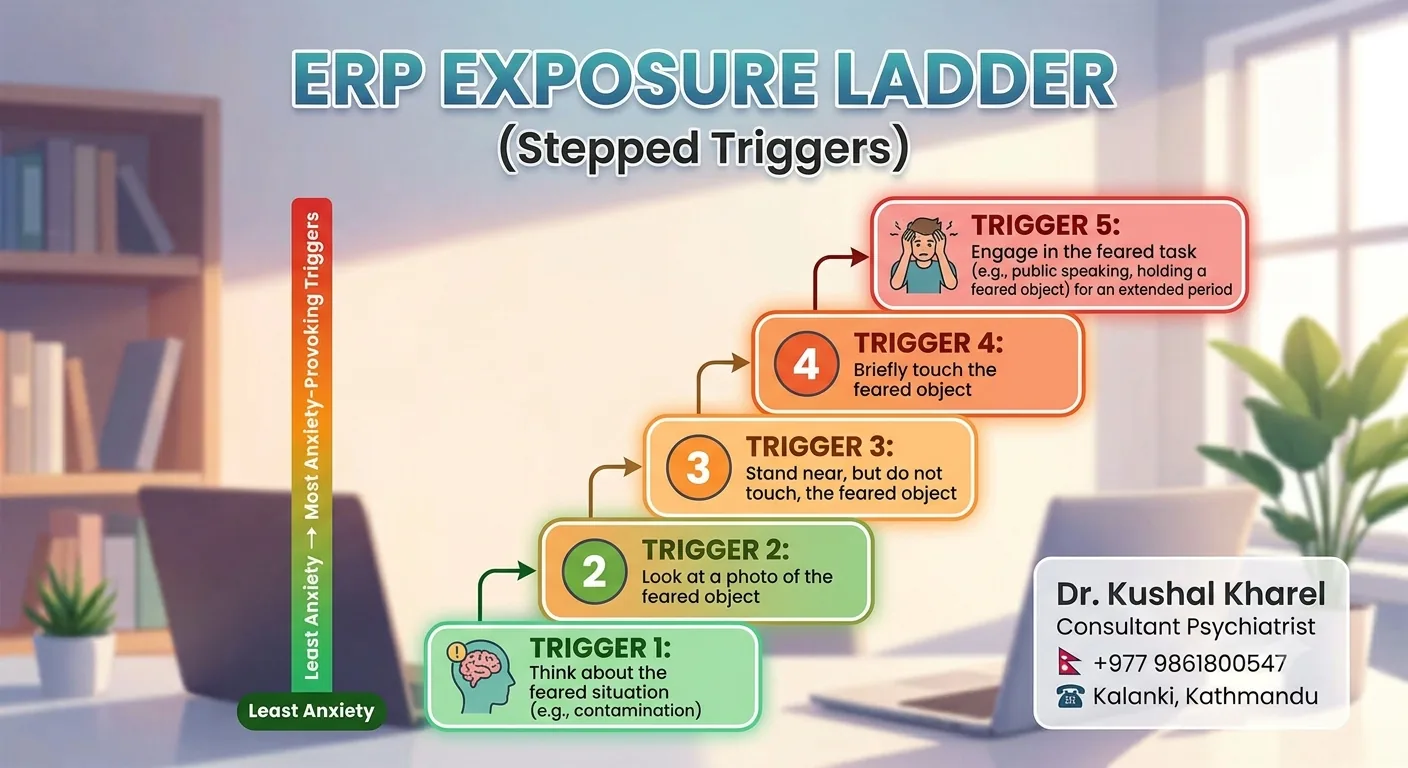
| Psychotherapy | Exposure and Response Prevention (ERP) | The core, most effective treatment — gradual, planned exposure to feared triggers while resisting the urge to perform compulsions, allowing anxiety to naturally decline. |
| Psychotherapy | Cognitive Behavioral Therapy | Addresses distorted beliefs such as 'thought-action fusion' (believing a thought is as bad as the act itself). |
What medications are used for Obsessive-Compulsive Disorder (OCD)?
- SSRIs (e.g., sertraline, fluoxetine, fluvoxamine)
- First-line; OCD typically requires higher doses and a longer trial (up to 12 weeks) than for depression before judging response.
- Clomipramine
- A tricyclic antidepressant with strong evidence in OCD, used when SSRIs are insufficient, though with more side effects.
- Antipsychotic augmentation (e.g., low-dose risperidone, aripiprazole)
- Added to an SSRI for treatment-resistant OCD under specialist supervision.
What therapy helps with Obsessive-Compulsive Disorder (OCD)?
- Exposure and Response Prevention (ERP)
- The core, most effective treatment — gradual, planned exposure to feared triggers while resisting the urge to perform compulsions, allowing anxiety to naturally decline.
- Cognitive Behavioral Therapy
- Addresses distorted beliefs such as 'thought-action fusion' (believing a thought is as bad as the act itself).
What lifestyle changes help with Obsessive-Compulsive Disorder (OCD)?
- Practice resisting compulsions gradually rather than all at once, following an ERP hierarchy
- Avoid seeking repeated reassurance from family or online sources, which reinforces the OCD cycle
- Track obsession/compulsion time to notice gradual improvement
- Maintain regular sleep and stress-management routines, since stress intensifies symptoms
- Involve family in understanding ERP so home life doesn't inadvertently accommodate rituals
What is the long-term outlook for Obsessive-Compulsive Disorder (OCD)?
Without treatment, OCD tends to follow a chronic, waxing-and-waning course. With ERP and/or medication, the majority of people achieve substantial symptom reduction, and many achieve full remission, though a subset with severe or treatment-resistant OCD may need combination treatment or, rarely, more advanced interventions in specialist settings.
Can Obsessive-Compulsive Disorder (OCD) be prevented?
- Early treatment when obsessions or compulsions first begin to consume significant time
- Family psychoeducation to avoid unintentionally reinforcing rituals through accommodation
- Prompt medical evaluation for sudden-onset symptoms in children (to screen for PANDAS/PANS)
How can family help someone with Obsessive-Compulsive Disorder (OCD)?
The single most important thing families can do is avoid 'accommodation' — participating in rituals, providing repeated reassurance, or helping avoid triggers — as this maintains and often worsens OCD over time, even though it reduces distress in the moment. Learn the basic principles of ERP so you can support treatment consistently, and reduce accommodation gradually and collaboratively with the treating clinician rather than abruptly.
Frequently Asked Questions
Is OCD just being very clean or organized?
No. Liking cleanliness or order is a personal preference; OCD involves intrusive, distressing thoughts and compulsions that consume significant time and cause real suffering, regardless of the specific theme.
Do people with OCD always know their fears are irrational?
Many do (referred to as 'good insight'), but some have poor or absent insight and are genuinely convinced the feared outcome is real, which doesn't change the diagnosis but can affect treatment engagement.
Why doesn't performing the compulsion make the anxiety go away for good?
Compulsions only provide short-term relief; they prevent the brain from learning that the feared outcome wouldn't have happened anyway, which is why the obsession returns, often more intensely.
Can OCD be fully cured?
Many people achieve full or near-full remission with ERP and/or medication. Others manage OCD as a long-term condition with periods of good control and occasional flare-ups during stress.
What is OCD?
OCD (Obsessive-Compulsive Disorder) is a psychiatric condition involving intrusive, unwanted thoughts (obsessions) that cause anxiety, and repetitive behaviors or mental acts (compulsions) performed to reduce that anxiety, consuming significant time and causing distress.
Can OCD go away on its own without treatment?
OCD rarely resolves fully without treatment and tends to follow a chronic, waxing-and-waning course if untreated. Structured treatment — particularly Exposure and Response Prevention — produces substantially better and faster outcomes than waiting it out.
Is OCD hereditary?
Yes, OCD has a notable genetic component, with heritability estimated at 40-50%. Having a close relative with OCD increases risk, though environmental factors and individual brain chemistry also play a significant role.
What treatments work for OCD?
Exposure and Response Prevention (ERP), a specialized form of CBT, is the gold-standard treatment for OCD. SSRIs at higher-than-typical doses are the first-line medication, and combining ERP with an SSRI is often recommended for moderate-to-severe OCD.
How effective is CBT (ERP) for OCD?
Exposure and Response Prevention, the specific CBT approach used for OCD, is highly effective, producing significant symptom reduction in most patients who complete treatment, with many achieving lasting remission when combined with medication when needed.
Are medications necessary for OCD?
Not always — mild OCD can respond well to ERP alone. Medication is generally recommended for moderate-to-severe OCD or when therapy alone isn't sufficient, and SSRIs at higher doses are the typical first-line choice.
Is there an OCD specialist in Nepal?
Yes. Dr. Kushal Kharel, a Consultant Psychiatrist in Kathmandu, treats obsessive-compulsive disorder using evidence-based Exposure and Response Prevention therapy and medication when appropriate, in person or via online consultation.
Myth vs Fact
Myth: OCD is a personality quirk, not a real medical condition.
Fact: OCD is a recognized psychiatric disorder with a distinct neurobiological basis and well-established, effective treatments.
Myth: People 'joke' about being 'a little OCD' about tidiness.
Fact: Clinical OCD causes real distress and consumes significant time; it is categorically different from a preference for tidiness.
Myth: Avoiding triggers is the best way to manage OCD.
Fact: Avoidance provides short-term relief but reinforces the disorder long-term; structured exposure (ERP) is the effective, evidence-based approach.
When should you seek urgent care for Obsessive-Compulsive Disorder (OCD)?
Seek urgent psychiatric care if OCD is causing an inability to work, attend school, or leave the house, if compulsions are causing physical injury (e.g., skin damage from excessive washing), or if obsessions are accompanied by thoughts of self-harm or suicide.
References
- American Psychiatric Association. Diagnostic and Statistical Manual of Mental Disorders, 5th Edition, Text Revision (DSM-5-TR).
- World Health Organization. International Classification of Diseases, 11th Revision (ICD-11).
- National Institute for Health and Care Excellence (NICE). Obsessive-compulsive disorder and body dysmorphic disorder: treatment.
- International OCD Foundation.
From the Blog
Related Obsessive-Compulsive and Related Disorders
Need professional help?
If these symptoms are affecting your sleep, work, relationships or daily functioning, a psychiatric assessment can help clarify the diagnosis and treatment plan.