Key Facts
Panic Disorder is characterized not simply by having panic attacks — which can occur in many anxiety and mood conditions — but by the pattern of recurrent, unexpected attacks combined with ongoing worry about having another one, or a significant change in behavior to avoid triggering an attack. This anticipatory anxiety and behavioral avoidance often become more disabling than the attacks themselves, and without treatment can narrow a person's life considerably as they avoid more and more situations.
Common symptoms
- Sudden surge of intense fear or discomfort peaking within minutes
- Palpitations, pounding heart, or accelerated heart rate
- Sweating, trembling, or shaking
- Shortness of breath or a smothering sensation
Key risk factors
- Family history of panic disorder or other anxiety disorders
- Female sex
- History of childhood physical or sexual abuse
Do I have panic disorder?
Take a free, confidential self-rated screening for panic disorder.
Downloadable resources
What is Panic Disorder?
Panic Disorder is characterized not simply by having panic attacks — which can occur in many anxiety and mood conditions — but by the pattern of recurrent, unexpected attacks combined with ongoing worry about having another one, or a significant change in behavior to avoid triggering an attack. This anticipatory anxiety and behavioral avoidance often become more disabling than the attacks themselves, and without treatment can narrow a person's life considerably as they avoid more and more situations.
Definition
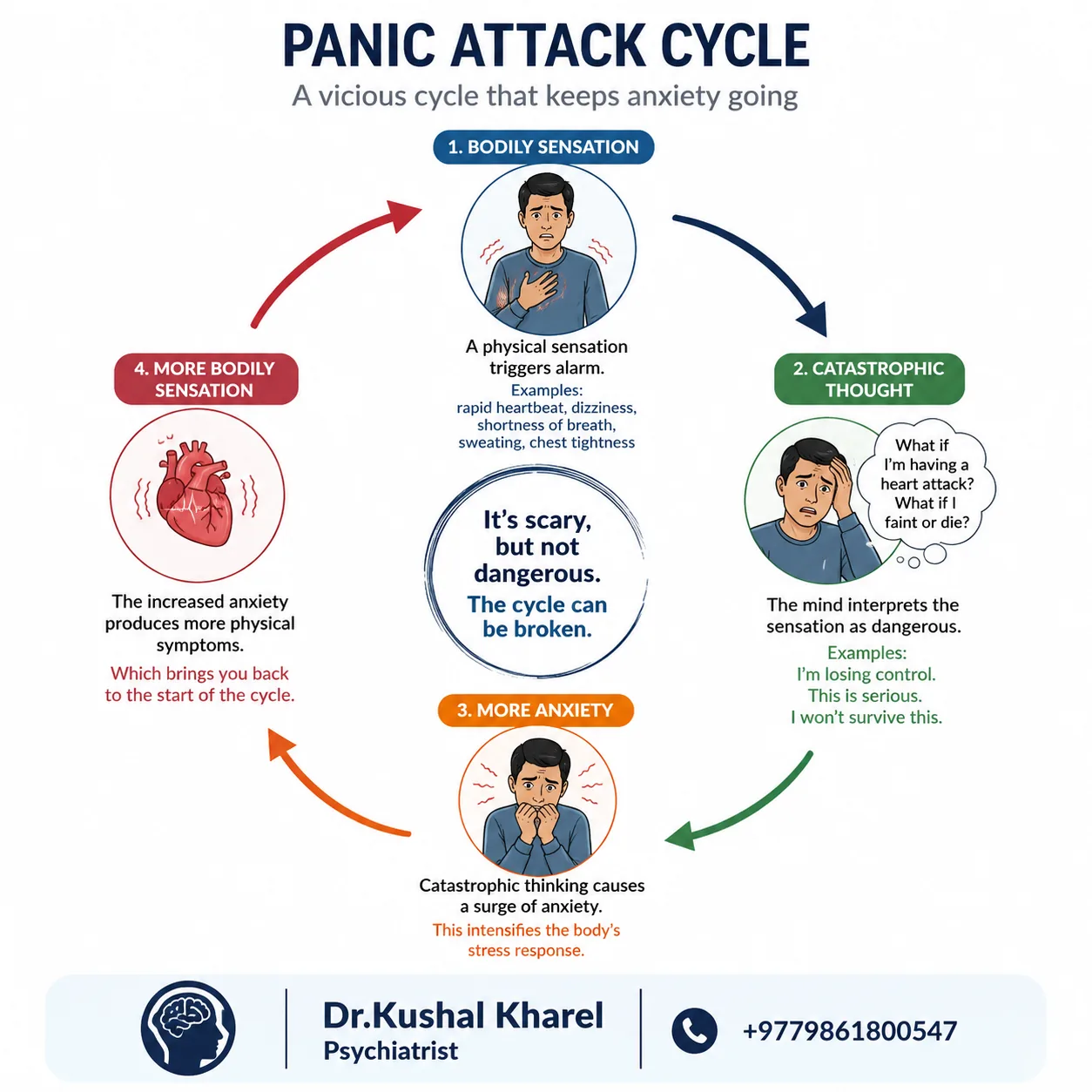
Panic Disorder involves recurrent unexpected panic attacks, with at least one attack followed by one month or more of persistent concern about additional attacks, worry about the implications of an attack (such as losing control, having a heart attack, or 'going crazy'), or a significant maladaptive change in behavior related to the attacks (such as avoiding exercise or unfamiliar places).
What causes Panic Disorder?
Panic Disorder arises from a combination of genetic vulnerability and dysregulation of the brain's fear-alarm system, which misfires in the absence of real danger. Many first episodes follow a period of significant stress, a major loss, a physical illness, or, in some cases, substance use. Once an initial panic attack occurs, the person often develops a conditioned fear of the bodily sensations themselves (a racing heart, breathlessness) which can trigger a self-reinforcing cycle where fear of the sensations produces more of the sensations.
What are the risk factors for Panic Disorder?
- Family history of panic disorder or other anxiety disorders
- Female sex
- History of childhood physical or sexual abuse
- Major life stress, loss, or transition
- Smoking and high caffeine intake
- History of other anxiety disorders or depression
- Behaviorally inhibited or anxiety-sensitive temperament
What happens in the brain with Panic Disorder?
Panic attacks are thought to arise from a hypersensitive fear network centered on the amygdala and its connections to the brainstem, including the locus coeruleus (the brain's primary noradrenaline source, which drives the surge of physical symptoms). One influential model, the 'false suffocation alarm' theory, suggests the brain's carbon-dioxide sensing system is oversensitive in panic disorder, triggering an air-hunger and suffocation alarm even when oxygen levels are normal — explaining why breathlessness and choking sensations are so prominent during attacks.
What are the symptoms of Panic Disorder?
- Sudden surge of intense fear or discomfort peaking within minutes
- Palpitations, pounding heart, or accelerated heart rate
- Sweating, trembling, or shaking
- Shortness of breath or a smothering sensation
- Feelings of choking
- Chest pain or discomfort
- Nausea or abdominal distress
- Dizziness, light-headedness, or feeling faint
- Chills or hot flushes
- Numbness or tingling sensations
- Derealization (feeling of unreality) or depersonalization (feeling detached from oneself)
- Fear of losing control, 'going crazy,' or dying
How is Panic Disorder diagnosed?
- Recurrent, unexpected panic attacks (a sudden surge of intense fear peaking within minutes, with 4 or more physical/cognitive symptoms)
- At least one attack has been followed by 1+ month of persistent concern about additional attacks, worry about the consequences of an attack, or a significant behavior change to avoid attacks
- Not attributable to the physiological effects of a substance or another medical condition
- Not better explained by another mental disorder (e.g., attacks not only in response to feared social situations, as in social anxiety disorder)
Differential Diagnosis
Conditions a psychiatrist will consider and rule out before confirming this diagnosis:
- Cardiac arrhythmia or coronary artery disease
- A first panic attack, especially with chest pain, should be medically evaluated to exclude a cardiac cause before assuming an anxiety diagnosis.
- Hyperthyroidism
- Produces palpitations, tremor, and anxiety; thyroid function tests help distinguish this.
- Pheochromocytoma
- A rare adrenal tumor causing episodic surges of catecholamines that can closely mimic panic attacks.
- Asthma or pulmonary embolism
- Both cause breathlessness that must be distinguished from panic-related breathlessness.
- Substance intoxication or withdrawal
- Stimulants, caffeine excess, and alcohol/sedative withdrawal can all provoke panic-like episodes.
- Generalized Anxiety Disorder
- GAD involves continuous worry rather than discrete, sudden attacks.
What tests are used to assess Panic Disorder?
- Detailed clinical psychiatric interview and attack history
- ECG to exclude cardiac arrhythmia, especially with chest pain
- Thyroid function tests
- Panic Disorder Severity Scale (PDSS) to grade severity
- Review of caffeine, stimulant, and substance use
How is Panic Disorder treated?
Cognitive Behavioral Therapy — particularly with an interoceptive exposure component (deliberately and safely provoking feared bodily sensations to break the fear-of-fear cycle) — is highly effective and considered first-line. Medication, usually an SSRI or SNRI, is commonly used alongside therapy or when therapy access is limited, especially for moderate-to-severe presentations.
Treatment at a Glance
| Type | Approach | Notes |
|---|---|---|
| Medication | SSRIs (e.g., sertraline, paroxetine, escitalopram) | First-line long-term medication; started at a low dose since panic-prone patients can be sensitive to initial jitteriness. |
| Medication | SNRIs (e.g., venlafaxine) | An effective alternative or second option to SSRIs. |
| Medication | Benzodiazepines (e.g., alprazolam, clonazepam) | Fast-acting relief for acute attacks or during initial treatment, used short-term due to dependence risk. |
| Medication | Tricyclic antidepressants (e.g., imipramine) | An effective second-line option when SSRIs/SNRIs are not tolerated or ineffective. |
| Psychotherapy | Cognitive Behavioral Therapy (CBT) | First-line psychotherapy; combines cognitive restructuring of catastrophic misinterpretations with gradual exposure. |
| Psychotherapy | Interoceptive exposure | A core CBT technique where feared physical sensations (dizziness, breathlessness) are deliberately induced in a safe setting to reduce fear of the sensations themselves. |
| Psychotherapy | Panic-focused psychodynamic psychotherapy | Explores underlying emotional conflicts thought to contribute to panic vulnerability. |
What medications are used for Panic Disorder?
- SSRIs (e.g., sertraline, paroxetine, escitalopram)
- First-line long-term medication; started at a low dose since panic-prone patients can be sensitive to initial jitteriness.
- SNRIs (e.g., venlafaxine)
- An effective alternative or second option to SSRIs.
- Benzodiazepines (e.g., alprazolam, clonazepam)
- Fast-acting relief for acute attacks or during initial treatment, used short-term due to dependence risk.
- Tricyclic antidepressants (e.g., imipramine)
- An effective second-line option when SSRIs/SNRIs are not tolerated or ineffective.
What therapy helps with Panic Disorder?
- Cognitive Behavioral Therapy (CBT)
- First-line psychotherapy; combines cognitive restructuring of catastrophic misinterpretations with gradual exposure.
- Interoceptive exposure
- A core CBT technique where feared physical sensations (dizziness, breathlessness) are deliberately induced in a safe setting to reduce fear of the sensations themselves.
- Panic-focused psychodynamic psychotherapy
- Explores underlying emotional conflicts thought to contribute to panic vulnerability.
What lifestyle changes help with Panic Disorder?
- Reduce or eliminate caffeine and stimulant intake
- Practice slow, diaphragmatic breathing regularly, not only during attacks
- Engage in regular aerobic exercise, which reduces overall anxiety sensitivity
- Avoid using alcohol to 'calm down,' which worsens the disorder over time
- Maintain a regular sleep schedule
- Gradually re-enter avoided situations rather than escalating avoidance
What is the long-term outlook for Panic Disorder?
Panic Disorder responds very well to treatment, with most people achieving substantial reduction in attack frequency and severity within a few months. Left untreated, it frequently leads to agoraphobia and significant lifestyle restriction. Relapse can occur during stressful periods, but people who have learned CBT skills typically manage recurrences more effectively.
Can Panic Disorder be prevented?
- Early treatment after a first panic attack to prevent the fear-of-fear cycle from becoming established
- Limiting stimulant and caffeine intake, particularly in anxiety-prone individuals
- Stress management and regular physical activity
- Avoiding avoidance — continuing to engage in daily activities after an isolated attack rather than withdrawing
How can family help someone with Panic Disorder?
Learn that panic attacks, while terrifying, are not medically dangerous — this understanding helps families respond calmly rather than reinforcing fear. Avoid encouraging avoidance (e.g., always driving instead of letting the person try public transport); instead, support gradual, agreed steps back into avoided situations. Accompanying someone to an initial exposure practice can help, provided the plan is to gradually reduce this support over time.
Frequently Asked Questions
Can a panic attack cause a heart attack or kill me?
No. Panic attacks are intensely distressing but are not physically dangerous. That said, a first-ever attack, or new chest pain, should always be medically assessed to rule out a genuine cardiac cause.
How long does a panic attack usually last?
Panic attacks typically peak within about 10 minutes and usually resolve within 20–30 minutes, though the lingering feeling of exhaustion or unease can last longer.
Why do I feel like I'm dying or losing control during an attack?
These sensations are produced by an intense surge of adrenaline and the brain's alarm system activating without real danger present — they feel real but do not reflect actual physical danger.
Will I need medication forever?
Not necessarily. Many people successfully taper off medication after 6–12 months of stability, particularly once they've also completed CBT and learned durable coping skills.
What triggers panic attacks in panic disorder?
Attacks in panic disorder are classically unexpected, arising without an obvious external trigger, though stress, sleep deprivation, caffeine, and heightened sensitivity to normal bodily sensations can increase vulnerability to an attack.
Can panic disorder be fully cured?
Many people achieve complete remission of panic attacks with CBT and/or medication, though some may experience occasional recurrence during high-stress periods, which learned coping skills typically manage effectively.
Is panic disorder hereditary?
Panic disorder has a genetic component — having a first-degree relative with panic disorder or another anxiety disorder increases risk, though environmental factors and life stress also play a significant role.
How is panic disorder different from generalized anxiety disorder?
Panic disorder involves sudden, discrete attacks of intense fear peaking within minutes, while generalized anxiety disorder involves persistent, diffuse worry across many areas of life without discrete attack episodes.
Can exercise help manage panic disorder?
Yes. Regular aerobic exercise reduces overall anxiety sensitivity and can lower panic attack frequency over time, though starting cautiously matters since exercise itself raises heart rate, a common trigger sensation.
How is panic disorder diagnosed?
Diagnosis is made through clinical interview establishing a pattern of recurrent, unexpected panic attacks followed by a month or more of worry about future attacks or significant behavior change, after ruling out medical causes.
Where can I get panic disorder treatment in Kathmandu?
Dr. Kushal Kharel, a Consultant Psychiatrist in Kathmandu, provides panic disorder treatment using evidence-based CBT with interoceptive exposure and medication when needed, available in person or via online consultation.
Myth vs Fact
Myth: Panic attacks mean you're going crazy or losing your mind.
Fact: Panic attacks are an intense but time-limited misfiring of the body's normal fear response — they do not indicate psychosis or 'losing your mind.'
Myth: If you just avoid stressful situations, panic disorder goes away.
Fact: Avoidance typically worsens panic disorder over time by reinforcing fear and often leads to agoraphobia; gradual, supported exposure is part of effective treatment.
Myth: Breathing into a paper bag is the main treatment for panic attacks.
Fact: Slow, controlled breathing helps in the moment, but lasting treatment requires CBT and/or medication addressing the underlying disorder.
When should you seek urgent care for Panic Disorder?
Seek immediate medical attention for a first-ever panic attack, new or unexplained chest pain, or if you cannot distinguish panic symptoms from a possible cardiac or other medical emergency. Seek urgent psychiatric review if avoidance has progressed to the point of being unable to leave home, or if panic is accompanied by thoughts of self-harm.
References
- American Psychiatric Association. Diagnostic and Statistical Manual of Mental Disorders, 5th Edition, Text Revision (DSM-5-TR).
- World Health Organization. International Classification of Diseases, 11th Revision (ICD-11).
- National Institute for Health and Care Excellence (NICE). Generalised anxiety disorder and panic disorder in adults: management.
- National Institute of Mental Health (NIMH). Panic Disorder: When Fear Overwhelms.
From the Blog
Related Anxiety Disorders
Need professional help?
If these symptoms are affecting your sleep, work, relationships or daily functioning, a psychiatric assessment can help clarify the diagnosis and treatment plan.